
Fireplace Guides
Natural Gas vs Propane Fireplace: Supply, Storage and Model Fit
Natural gas and propane can support excellent fireplaces, but the right fuel is the one the property can supply safely and the exact appliance is approved to use.
Before you compare
Start with the property and equipment
Choose natural gas when the property has a verified service and enough system capacity for the proposed fireplace and other appliances. Choose propane when natural gas is unavailable and a compliant storage and supply arrangement can support the project. Do not choose by flame appearance or an online fuel-price claim: compare availability, supply infrastructure, model compatibility, project scope and how the household expects to operate the fireplace.
Begin with fuel availability, not preference
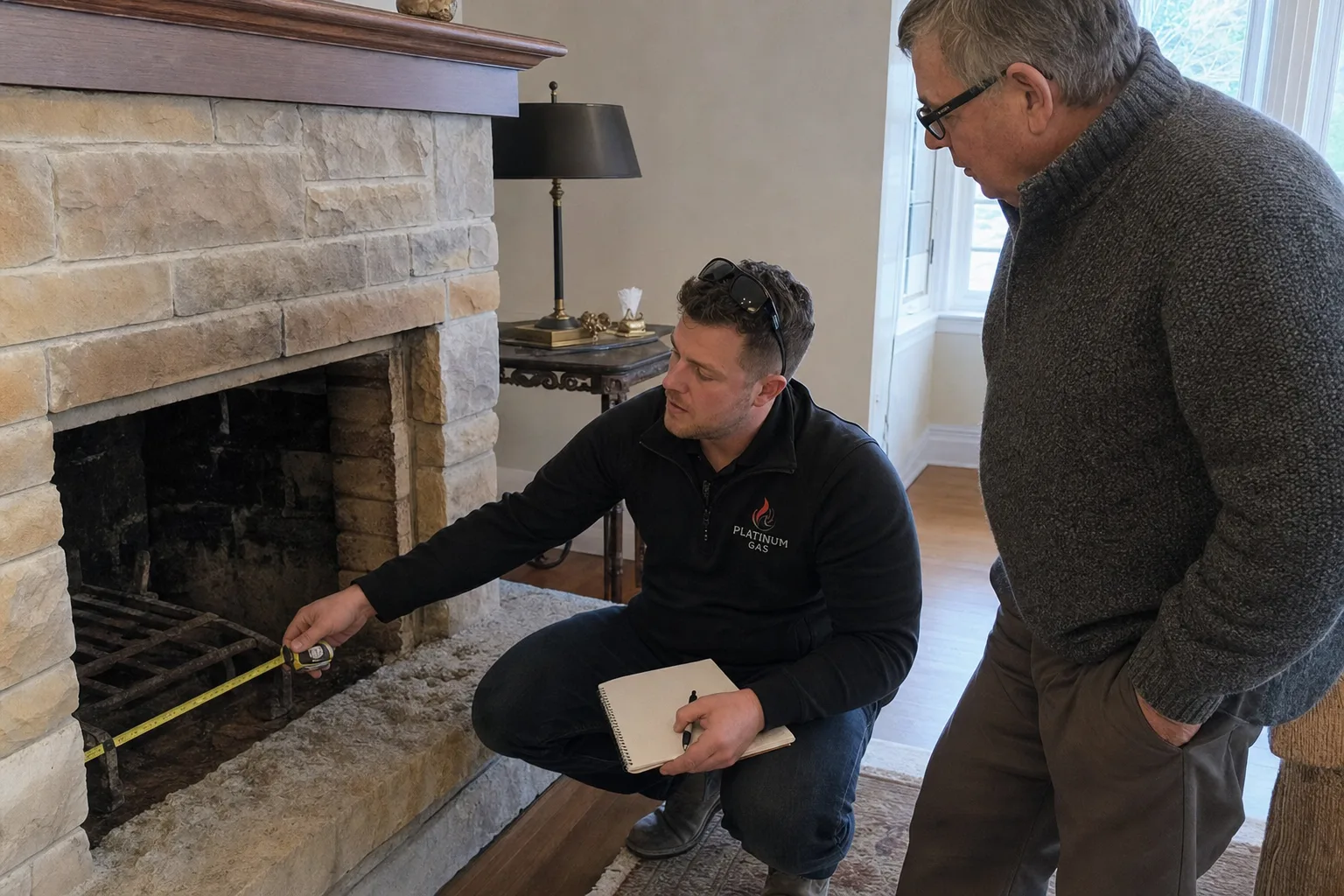
A natural-gas connection at the street does not confirm service to the house, and a gas meter does not confirm spare capacity. Existing appliances, meter or regulator conditions, line sizing and the proposed fireplace demand all need review. For propane, the storage system, regulator arrangement, delivery access and other connected loads become part of the project.
Bring the current appliance list and any future plans to the assessment. A pool heater, range, barbecue or outdoor fire feature can change the larger fuel-supply plan. Reviewing the system once is more useful than placing a fireplace connection without considering the next project.
- Confirm whether natural gas service actually reaches the property.
- Record existing fuel-burning appliances and future plans.
- For propane, include storage, regulator and delivery context.
- Have capacity and routing assessed before ordering a unit.
Match the fireplace to its approved fuel version
Manufacturers often sell related natural-gas and propane versions, but burner orifices, valves, pressure settings and approved components differ. The rating plate and current manual identify the fuel for the exact appliance. Some models permit conversion with a manufacturer-approved kit and procedure; others do not. A second-hand listing or showroom label is not sufficient evidence.
Confirm fuel before the order is placed and again when the equipment arrives. Keep the model, serial and manual with the home records. A fuel mismatch is not solved by field improvisation, and a technician should not be asked to make an unapproved unit fit the available supply.
Compare the complete supply system
Natural gas is delivered through the utility network and the property system. Propane is stored on site and replenished by a supplier. That changes questions about tank location, delivery access, refill planning and how several appliances share the available supply. It does not make one fuel inherently better for every home.
In either case, the line route, pressure conditions, shutoff accessibility and total connected demand must support the exact fireplace. The presence of a nearby pipe is not proof of capacity. Ask the assessment to identify whether the existing system can be reused, needs modification or requires coordination with a utility or propane supplier.
Before you choose equipment
Find the right fit for your home
Tell us which models you like and where you want the appliance. We can help check the fuel supply, venting, space and access before you buy.
Avoid universal operating-cost claims
Fuel prices vary by utility, propane supplier, contract, delivery arrangement, location and date. Fireplace consumption also changes with input rate, modulation, set point and hours of use. Comparing a single natural-gas rate with a single propane price can create a confident answer that does not match the household bill.
For a useful estimate, compare the exact model input range, expected weekly use and current local bill information on the same date. Include fixed or delivery charges only when they genuinely change because of the project. Treat the result as a scenario, not a guarantee, and keep comfort and construction differences in the decision.
- Use current local bills or supplier quotes with dates.
- Compare the exact model input range and expected hours.
- Keep units consistent when comparing fuels.
- Do not assume a historical rate predicts future operating cost.
Flame, heat and controls depend more on the model
Fuel type alone does not determine flame quality, viewing size, heat distribution or control experience. Those characteristics depend on the appliance design, burner, media, turndown, blower and control package. Compare current specifications for candidate models in the correct fuel version rather than treating all propane or natural-gas units as one class.
Room fit remains important. A model that delivers too much heat at low fire can be uncomfortable regardless of fuel. Ask how the fireplace performs across its output range, which features require household power and what remains available during an outage. The answer must come from the exact manual.
Compare fuels for your home and fireplace
List the available fuel infrastructure, other loads, room and wall conditions, vent route, heat goal, preferred style, control needs and service access. Then compare only appliances approved for the available fuel and installation. Propane may fit outside the natural-gas network; an existing natural-gas system may reduce new supply infrastructure when capacity is adequate.
Request a written quote that explains the gas supply, fireplace model, venting, electrical work, finishes and startup checks, including who does what and anything not included. That turns a broad fuel question into a plan for this house and avoids letting a temporary promotion or general price claim make a long-term equipment decision.
- Verify supply and connected load.
- Confirm the exact approved fuel version.
- Compare current manuals, output and controls.
- Price the complete project, not fuel in isolation.
Questions we hear
Frequently asked questions
Not in a way that supports a universal rule. Flame presentation depends on the exact appliance, burner and media design. Compare approved natural-gas and propane models in operation and review their current specifications.
Only when the exact manufacturer documentation permits conversion and specifies an approved kit and procedure. Some appliances cannot be converted. The work is not a homeowner adjustment.
No universal claim is reliable. Rates, delivery arrangements, model input and hours of use vary. Compare dated local costs and the exact appliance for a defined use scenario.
Possibly, but proximity does not establish capacity. A qualified assessment must consider the line, pressure, length, connected appliances and exact fireplace demand before reuse is confirmed.
Ask about your project
Tell us about the property and equipment
Send the service address, timing, appliance model and safe photos that show the work area.