
Safety and Maintenance
Annual Gas Fireplace Service Checklist: Owner Observations vs Technician Tasks
Know what you can check before fireplace season and what to leave to a technician, including gas components, burners, venting, glass seals and controls.
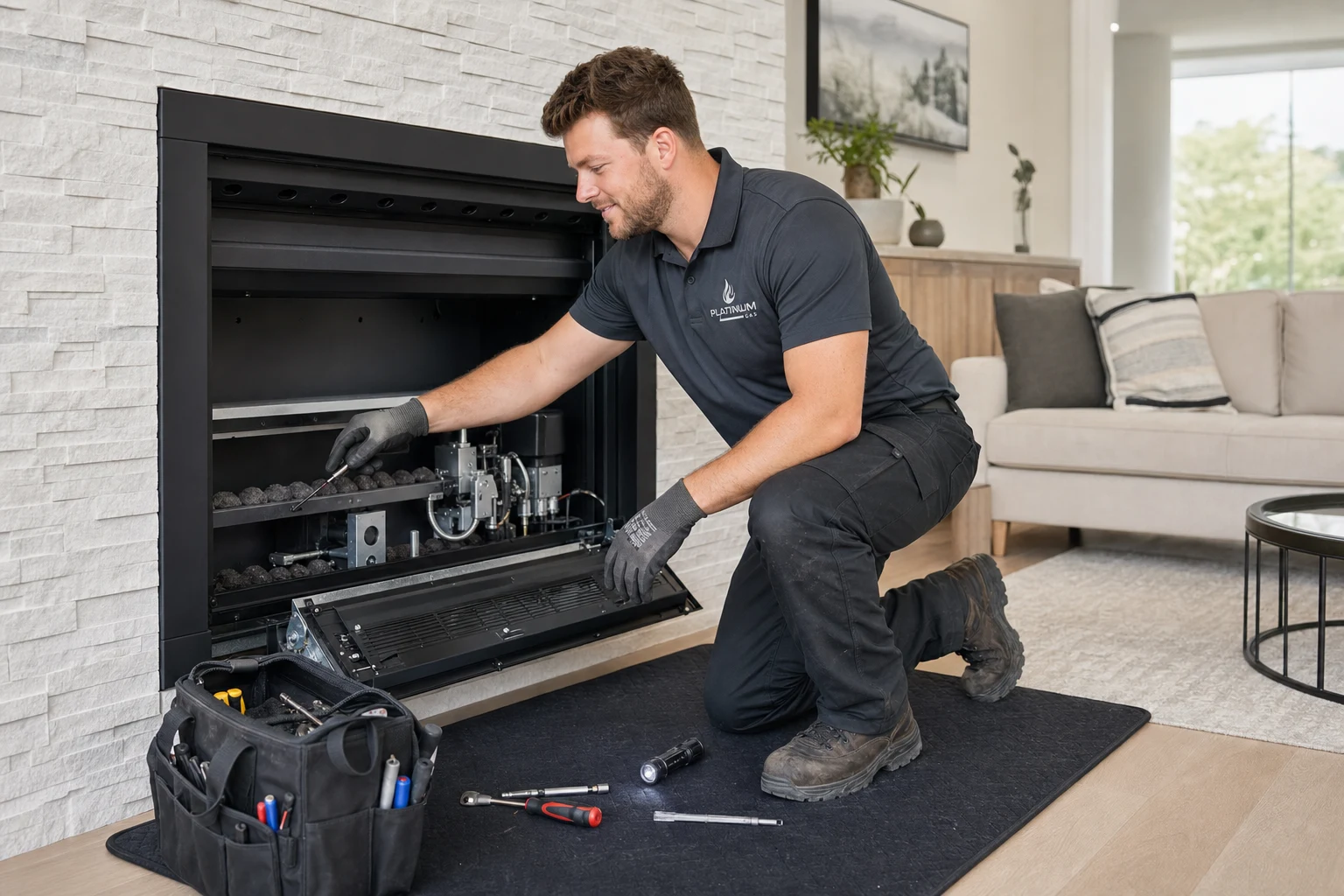
Safe checks
Start with what you can observe
Before regular fireplace use, owners can review the exact manual, test smoke and carbon-monoxide alarms as directed, keep the accessible exterior termination clear, confirm the safety barrier is secure, observe normal ignition and flame from outside the sealed firebox, and record new noise, residue, odour or control behaviour. A qualified technician handles gas pressure and leak testing, burner and ignition diagnosis, vent-system inspection, glass-seal assessment, control testing, internal cleaning and any part adjustment or replacement. Service timing should follow the manufacturer and operating conditions rather than one promise for every model.
Owner check: manuals, alarms and the room around the fireplace
Start with the manual for the exact model and fuel. Find the rating information without removing sealed or service-only panels. Review the manufacturer’s normal operating sequence, permitted owner cleaning and warning signs. If the manual is missing, use the manufacturer’s official support library and verify the model revision rather than relying on a general fireplace video.
Maintain smoke and carbon-monoxide alarms according to Ontario requirements and their manufacturer instructions. A CO alarm does not detect a natural-gas leak, and the odour added to natural gas does not warn of CO. Keep furniture, decorations and stored items away from the appliance as the manual requires. Confirm the safety barrier is present and secure, and teach children and guests that the glass and surrounding surfaces can become very hot.
- Locate the exact current owner manual.
- Test and maintain smoke and CO alarms as directed.
- Keep combustible items and furnishings appropriately clear.
- Confirm the safety barrier is secure and undamaged.
- Record model, serial, fuel and prior service information.
Owner check: normal startup and visible operation
Operate the fireplace only through its normal controls and watch the sequence from outside the sealed assembly. Record delayed or repeated ignition, shutdown, a fault display, unusual fan noise, remote problems or a meaningful change in flame. Compare only with the model manual’s description. Do not repeatedly reset a fault or keep operating to see whether a concerning condition clears.
Look for soot, unusual darkening, white film, cracked glass, a loose barrier, damaged trim or media that appears displaced. Do not open the glass or rearrange logs, embers or stones. Their placement can affect flame and combustion, and sealed-glass removal may require model-specific inspection and resealing. Clear photographs taken from outside the appliance can help service intake.
Owner check: the outside vent and normal controls
From a safe, ordinary-access location, check that the exterior termination is not blocked by leaves, snow, nests, stored items, vegetation or later construction. Do not climb, remove a cover, insert a tool or dismantle vent components. Enbridge recommends keeping outdoor appliance vents clear, particularly after storms. If the termination is damaged, iced or inaccessible, leave the fireplace off and request professional help.
Check remote batteries and ordinary user controls only as the owner manual permits. Note whether a wall switch, remote or thermostat behaves differently. Do not open control compartments, jump contacts, bypass a switch or replace components based on appearance. A control problem can be the symptom of another appliance condition, and the technician needs to see the original behaviour.
Need help with a problem?
Tell us what is happening
Note what you can see, hear or read from the normal controls. Do not remove panels, alter gas fittings or perform regulated tests yourself.
Technician task: gas, ignition, burner and combustion systems
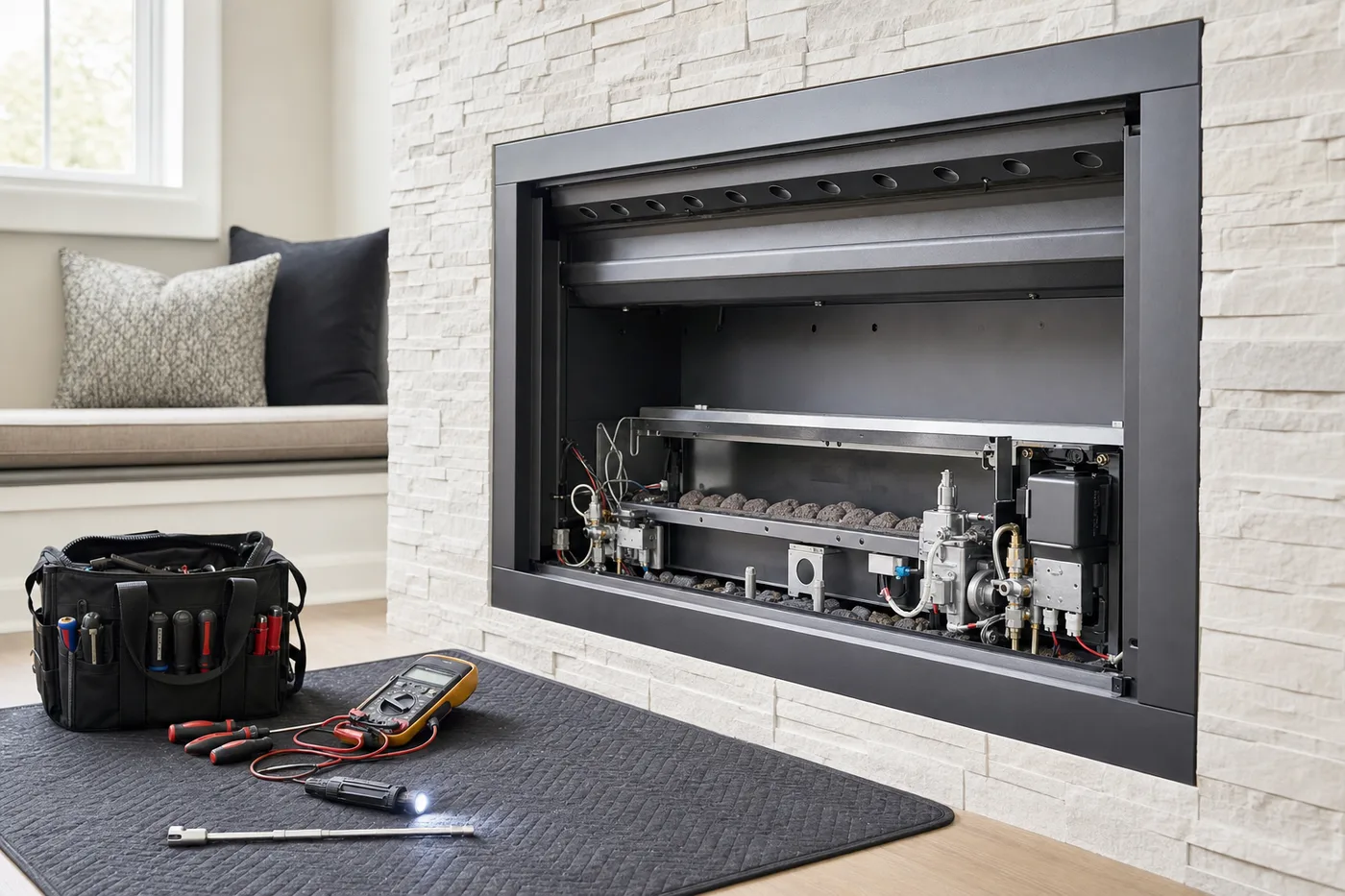
Qualified service can assess the appliance’s fuel and gas components, ignition sequence, flame proving, burner condition and manufacturer-specified operating values. The checks and work needed depend on the model and problem. These systems are not owner-maintenance items. Adjusting a pilot, regulator, gas valve, orifice, burner or air setting without the correct procedure and instruments can create unsafe operation.
The technician can distinguish normal characteristics from a fault and identify approved parts. Internal cleaning should protect burner ports, sensors, media placement and wiring rather than treating the firebox like an ordinary household surface. After any repair or adjustment, operation needs to be verified in accordance with the manufacturer information.
- Fuel, gas components and manufacturer operating values.
- Ignition sequence, flame proving and safety controls.
- Burner, pilot or ignition assembly condition.
- Approved media placement and internal cleaning.
- Operational verification after service.
Technician task: glass seal, venting and heat movement
The glass and gasket help maintain the appliance’s approved combustion system. A technician can inspect seating, latches, gasket condition and the correct replacement assembly. Substitute glass or generic gasket material is not appropriate. The vent system can be assessed for visible condition, secure connections, corrosion, obstruction, termination condition and concerns relevant to the exact fireplace and route.
Fans, louvers, heat-management components and accessible air passages can also be evaluated and cleaned as required. New noise, reduced airflow or overheating may originate from dust, component wear, installation conditions or controls. Service should address the cause and preserve access rather than masking noise or restricting airflow with finish modifications.
Ask what was done and what to watch for
Before the appointment, clear access and share the model, symptoms, photos and prior records. After service, ask what was observed, cleaned, tested, adjusted or replaced; which approved parts were used; and whether any follow-up remains. Keep the invoice and findings with the manual. If the unit is left out of service, confirm the condition required before it can operate again.
Use the completed visit as a baseline for normal flame, sound and controls. This makes future changes easier to describe. A Courtice homeowner who uses a fireplace daily may have different service needs from a household that uses one occasionally; manufacturer requirements, environment, symptoms and operating history should guide timing. Schedule before heavy-use season when possible rather than waiting for the first cold-day failure.
Questions we hear
Frequently asked questions
Only when the exact owner manual explicitly permits the procedure and you can follow it fully. Damaged glass, gasket concerns, media movement or uncertainty belong to qualified service.
No. CO is odourless and different from natural gas. For a natural-gas odour, leave and call 911 and Enbridge from a safe distance.
No. Follow the exact manufacturer instructions and consider use, environment, age and symptoms. Enbridge advises annual inspection of fuel-burning appliances by a registered contractor.
Provide the model, serial, fuel, symptom and timing, error code, photos from outside the sealed appliance and prior service information.
References
Sources and further reading
Ask about your project
Tell us about the property and equipment
Send the service address, timing, appliance model and safe photos that show the work area.