
Fireplace Guides
Best Gas Fireplace Brands? A Practical Ontario Buying Guide
Choosing a gas fireplace? Compare the look, heat, controls and installation needs, then find a model that suits your room and can be serviced locally.

Before you compare
Start with the property and equipment
The best gas fireplace for you depends on your home, not just the brand. Compare Canadian-approved models that suit your natural gas or propane supply, room size, heating needs and preferred controls. Check the venting, installation work, warranty and local service support before buying. The model must be approved for your fuel and the way it will be installed.
Before you choose
Check these details against the property
| Compare | What to assess |
|---|---|
| Use and comfort | Ambience, supplemental room heat, or both; compare low- and high-fire behaviour for the actual room. |
| Appliance format | Insert, factory-built fireplace, or freestanding design, based on the existing structure and design goal. |
| Site fit | Fuel, vent route, clearances, electrical needs, controls, finished wall, and service access. |
Start with the job the fireplace needs to do
Begin with use, not a catalogue image. A fireplace selected mainly for atmosphere can have a different heat range, flame presentation and control package from one expected to warm a frequently used family room. Tell the assessor when the room is occupied, whether doors usually remain open or closed, what other heating serves the space, and whether anyone is especially sensitive to overheating. A tall great room, a compact den and a finished basement can respond very differently even when their floor areas look similar.
Natural Resources Canada distinguishes decorative gas fireplaces from heating gas fireplaces in federal energy-efficiency rules. That distinction matters when comparing products: a large input number or dramatic flame does not, by itself, tell you how much useful heat reaches the room. Ask for the fireplace efficiency information, heat-output range and control options for the exact model. Think about low-fire comfort as well as maximum output, because a fireplace that can turn down appropriately may be more comfortable during shoulder seasons.
- Primary goal: visual focal point, supplemental room heat, or both.
- Usual occupancy: daily living space, occasional entertaining area, or seasonal room.
- Existing conditions: insulation, ceiling height, glazing, doors and other heat sources.
- Operating preferences: remote, thermostat, blower, lighting and low-flame control.
Natural gas and propane are related, not interchangeable
Many fireplace families are offered in natural-gas and propane versions, but the fuel must be established before equipment is ordered. Burner components, pressure requirements and approved conversion arrangements are model-specific. A property with an existing gas meter still needs its connected load and supply conditions assessed; the presence of a nearby pipe does not prove that it can support another appliance. A propane project also needs coordinated planning for the storage and supply system.
Discuss current and future fuel demand at the same visit. A pool heater, range, barbecue connection or outdoor fire feature can change the larger gas-line plan. This is not a homeowner pipe-sizing exercise. The useful preparation is an accurate appliance list, model information where available, photographs of accessible utility areas, and an explanation of future projects. The technician can then assess capacity, route, shutoff access and manufacturer requirements as one system rather than treating the fireplace as an isolated connection.
Compare fireplace formats for the room
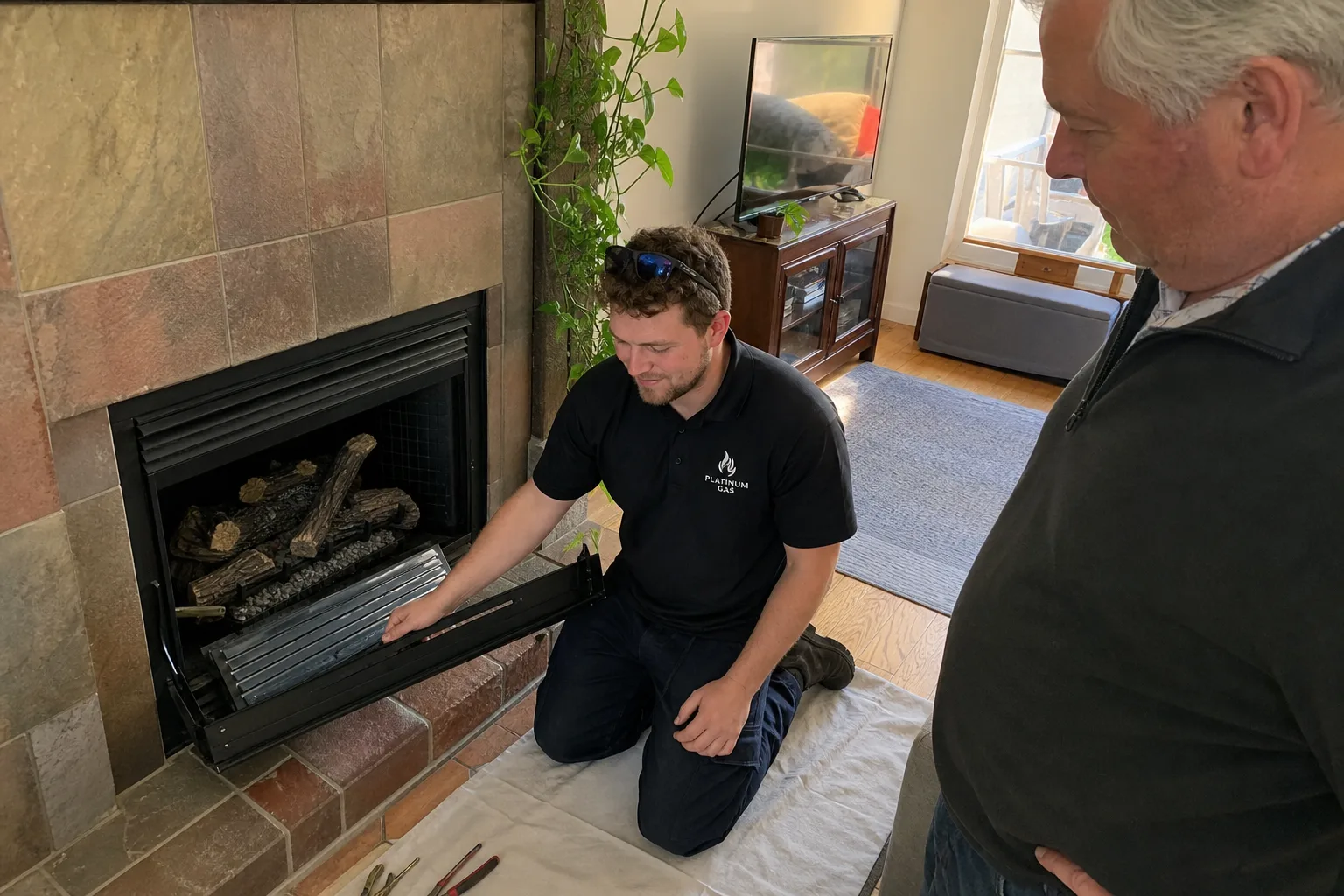
For Canadian homes, Natural Resources Canada describes three broad formats: inserts, factory-built fireplaces and freestanding designs. An insert is intended for an appropriate existing fireplace opening and normally uses an approved liner system through the chimney. A factory-built fireplace creates a new appliance installation in a framed or purpose-built enclosure. A freestanding gas stove exposes more of the appliance body to the room and has its own placement and clearance requirements. The correct format follows the existing structure and design goal.
An insert is not simply a small built-in fireplace pushed into any recess. The original fireplace, opening, chimney path, hearth, surround and service access all affect suitability. Conversely, a new built-in can offer more freedom over wall proportions and media style, but it may involve framing, non-combustible finishing, electrical work and coordination with other trades. See the fireplace inserts and conversions service to discuss an update to your existing fireplace, or the gas fireplace installation service for a new or replacement built-in.
Before you choose equipment
Find the right fit for your home
Tell us which models you like and where you want the appliance. We can help check the fuel supply, venting, space and access before you buy.
Venting is part of appliance selection
A vent route is not an accessory decision made after the fireplace is purchased. Direct-vent appliances draw combustion air from outdoors and discharge combustion products outdoors through an approved system. Natural-draft and power-vent arrangements operate differently. Each appliance manual defines the permitted vent components, route limits, elbows, rise, termination and clearances for that exact model. Exterior doors, windows, soffits, decks, grade, snow, neighbouring structures and the finished wall can all affect feasibility.
Vent-free gas fireplaces are not approved for use in Canada. They should not appear on a Canadian shortlist even if they are promoted on a U.S. website. Keep the conversation focused on approved vented products and a route that can be installed and later inspected. The Ontario homeowner venting guide explains the concepts without providing design dimensions or installation instructions.
Choose the fireplace size, heat output and style
Physical fit and heating fit are separate questions. The appliance needs an approved enclosure, clearances and vent arrangement, while the visible opening, surround and feature wall need to look intentional at normal viewing distance. A fireplace that is visually undersized can disappear in a broad wall; one selected only for a wide viewing area may deliver more heat than a compact room can use. Television placement, mantel geometry and heat-sensitive finishes must be checked against the exact manual rather than a generic inspiration image.
Bring room dimensions, ceiling height, photographs and a rough elevation of the wall to the first discussion. Note large windows, open stairways and connected rooms, but expect the final recommendation to require a site assessment. Ask to compare minimum and maximum heat output, fireplace efficiency, blower behaviour and control range. Avoid rules of thumb that promise a particular room size from input alone; envelope quality, layout, climate and use all influence comfort.
Compare exact models, not brand reputation alone
Compare each model with what you want from your fireplace. Use its current Canadian specification sheet and manual to check the fuel, viewing size, heat range, efficiency, ignition, venting, electrical needs, controls, fan, log or glass options, required clearances and warranty. Ask who can service it locally and how they will reach the parts once the wall is finished. The trim also needs to cover the opening properly.
Do not rely on an online ranking or assume every fireplace from one brand has the same requirements. Manuals vary by model and version. Your installer should use the manual supplied for your fireplace, and you should keep it with the model and serial number. Platinum Gas can help narrow down suitable options. Confirm availability and the installation work before ordering.
Plan the whole installation, including finishes and controls
A fireplace installation can involve removing the old unit, adding or updating the gas line and venting, framing the wall, using the required non-combustible materials, electrical work and finishing. Include the mantel, television position, outside vent, room protection, final safety checks and a demonstration of the controls in the plan. Agree on who handles each job before work starts. Gas connections, service access and the required clearances need to be right before stonework or cabinetry covers the wall.
Controls deserve an early decision. Some models use line power for fans, lights or enhanced controls even if the flame can operate during an outage. Others have different backup arrangements. Ask what will and will not function without household power for the exact model. Decide where switches, receptacles and remote storage belong before finishes are complete. Also ask how the glass is removed for service and how the rating plate and shutoff remain accessible.
Compare the full installation cost, not just the fireplace price
The fireplace price is only part of the total. Gas-line changes, venting, chimney liners, framing, electrical work, finishes and removal of the old fireplace can all affect the cost. One room photo may not show everything involved. Ask for a written quote that lists the equipment and work included, any permits or inspections needed, who handles the finishes, and anything that would cost extra.
Before requesting an assessment, gather the property address or service area, preferred fuel, room dimensions, photos of the entire wall and accessible fireplace or utility areas, desired style, heat goal and target timing. See the Project Ideas page for fireplace layouts, then use the quote form to share the actual conditions.
- Define ambience and heat goals before comparing models.
- Confirm fuel, connected appliances and any future gas plans.
- Assess the format, vent route, clearances and service access together.
- Compare current Canadian manuals and specifications for exact models.
- Document construction, finishing, electrical and trade responsibilities in the quote.
Questions we hear
Frequently asked questions
Square footage is only one input. Ceiling height, insulation, glazing, open connections to other rooms, other heating and the fireplace output range all affect comfort. Physical clearances, venting and wall proportions also need separate checks. Use room information to start an assessment, not as a stand-alone model selector.
No. An insert is made for an appropriate existing fireplace opening and normally uses an approved liner arrangement in the chimney. A built-in or factory-built fireplace creates a new appliance installation and enclosure. The existing structure, desired finish and vent route determine which format is suitable.
That creates avoidable risk. The exact fuel, heat range, vent route, clearances, framing, electrical needs, trim and service access should be assessed before equipment is ordered. A product that looks right online may not be approved for the proposed installation or fit the available route and clearances.
No. Natural Resources Canada states that vent-free gas fireplaces are not approved for use in Canada. Plan around an approved vented appliance and its exact manufacturer instructions.
References
Sources and further reading
Ask about your project
Tell us about the property and equipment
Send the service address, timing, appliance model and safe photos that show the work area.