
Fireplace Guides
Vented vs Vent-Free Gas Logs in Ontario: What Homeowners Should Know
Vent-free fireplaces are not approved for use in Canada. Here are the vented gas-log, insert and fireplace options to discuss for your Ontario home.
Before you compare
Start with the property and equipment
Vent-free or ventless gas fireplaces are not approved for use in Canada, according to Natural Resources Canada. Ontario homeowners should focus on approved vented options for the actual fireplace and application. Depending on the existing opening and project goal, that may involve an approved vented gas-log system, a gas insert with a specified liner arrangement, or a factory-built direct-vent fireplace. The chimney, combustion-air design, fuel, heat goal, clearances and manufacturer instructions determine the appropriate path.
Remove vent-free products from the Canadian shortlist
U.S. shopping pages often present vented and vent-free logs as two common choices. That framing does not transfer to Canada. Natural Resources Canada states that vent-free gas fireplaces are not approved for use in Canada. A product listing, online seller or cross-border availability does not establish Canadian approval or a suitable Ontario installation.
Do not attempt to solve a difficult chimney or vent route by selecting a ventless product. The project needs an approved vented system or a different appliance and location. Verify the current Canadian documentation for the exact model before purchase.
- Exclude vent-free and ventless gas fireplace products.
- Confirm Canadian approval and intended application.
- Use exact model and fuel documentation.
- Have the existing fireplace and vent route assessed.
How an approved vented gas-log set works
An approved vented gas-log system is installed in a suitable fireplace and operates with the venting arrangement required by its listing and instructions. The existing chimney and fireplace must be assessed; an open masonry cavity is not automatic approval. The log set, burner, controls, damper or vent provisions, fuel and clearances work as one system.
Vented logs are commonly selected for a traditional open-fire appearance rather than the controlled room-heating behaviour of a sealed insert. Compare the exact system's intended use and performance information. Do not rearrange logs, add embers or substitute controls outside the manual.
Compare a sealed gas insert for room heat
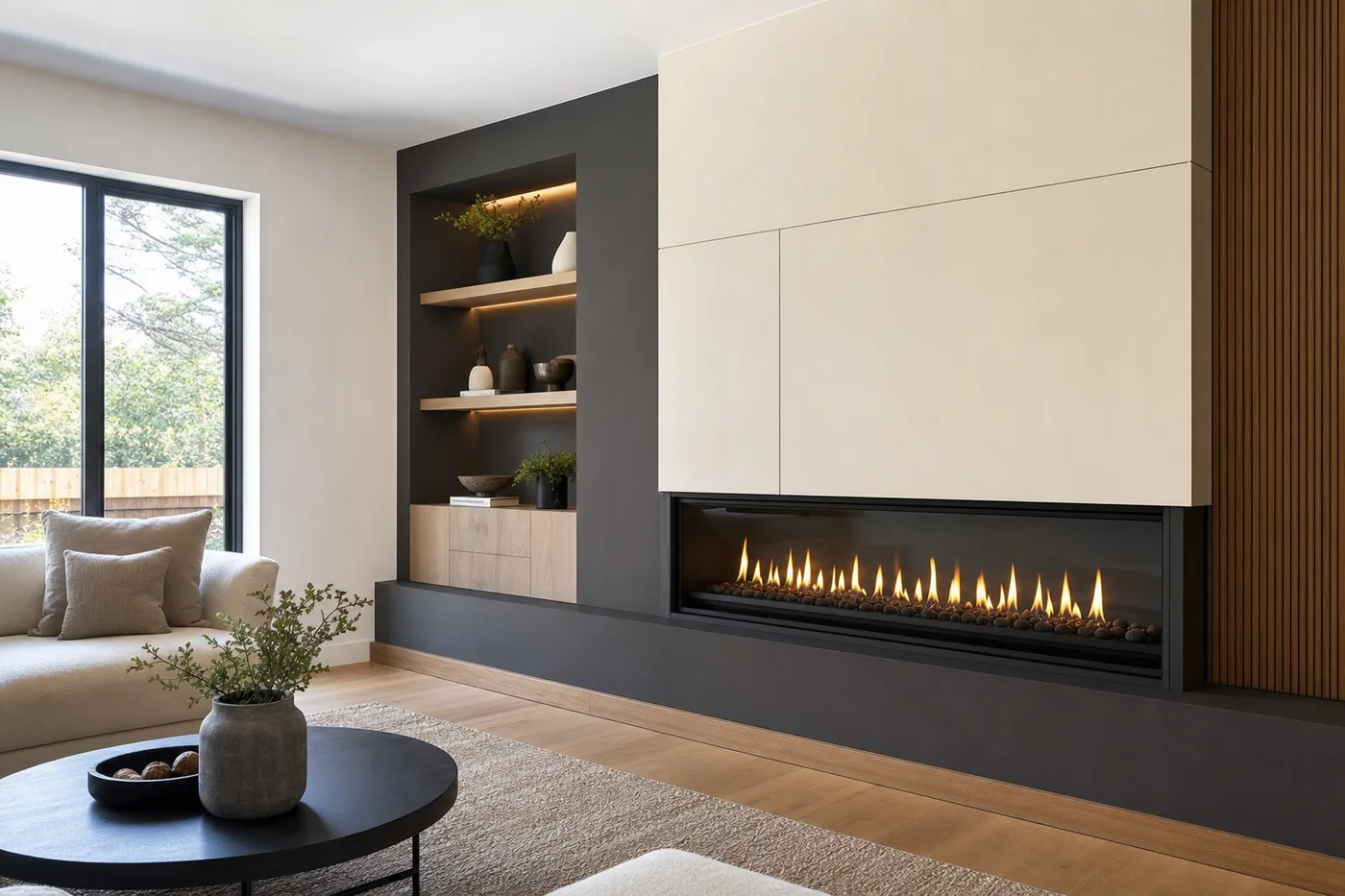
A gas insert can reuse an appropriate existing fireplace opening while using an approved liner system through the chimney. It encloses the fire behind glass and can provide a defined heat-output range, controls and often a blower. Opening dimensions, original fireplace type, chimney route, hearth, electrical needs, surround coverage and service access determine compatibility.
Natural Resources Canada notes that a chimney used for a gas insert requires an approved vent arrangement. Do not choose the insert from front dimensions alone. Compare useful output, low-fire comfort, controls, sound and verified fit.
Before you choose equipment
Find the right fit for your home
Tell us which models you like and where you want the appliance. We can help check the fuel supply, venting, space and access before you buy.
Consider a direct-vent fireplace when the project is broader
A factory-built direct-vent fireplace can suit a new feature wall, major replacement or different location. It uses its approved system to draw combustion air and discharge combustion products outdoors. The selected model defines vent components, route limits, termination, framing, clearances, electrical needs and finish conditions.
This path can offer more design freedom than an insert, but it usually involves more construction. Exterior openings, soffits, decks, snow, adjacent structures and service access shape feasibility. Do not finalize framing or finishes until the exact model and vent plan are confirmed.
What to ask before choosing a fireplace in Ontario
Describe whether the priority is open-fire ambience, useful room heat, a new architectural focal point or reuse of an existing opening. Provide photos of the fireplace, chimney, room and exterior, plus rough dimensions and fuel. Ask which approved Canadian systems fit and why, what the vent or liner plan involves, and how the appliance remains serviceable.
For an Oshawa assessment, include the exact address and building context. Avoid ordering from a cross-border listing or assuming a U.S. manual applies. Retain Canadian product documents, model and serial information at handover, and follow only the owner instructions for operation and cleaning.
Ask the assessor to explain the trade-offs in plain language: which option preserves more of the existing fireplace, which provides the desired heat and flame experience, what liner or vent arrangement is required, how the controls use power, what finish work is involved and how future service happens. A useful recommendation cites the exact approved equipment and verified site conditions. It does not depend on calling one category “best” or suggesting that a vent-free workaround is acceptable because construction would be easier.
Before work begins, keep the product page, current manual, fuel version, vent or liner plan and quote together. If you choose a different appliance, have the installer check it again. Two models that look alike may have different approvals, heat output and installation requirements.
- Primary goal: ambience, room heat or new feature wall.
- Existing opening, chimney and exterior route conditions.
- Canadian-approved model, fuel and current manual.
- Installation, finishing and future service scope.
Questions we hear
Frequently asked questions
Natural Resources Canada states that vent-free gas fireplaces are not approved for use in Canada. Focus on approved vented products and a site-specific professional assessment.
They serve a different application. Compare the exact approved system's intended use and performance with a sealed insert's output range, controls and blower rather than assuming equivalence.
No. The fireplace, chimney, venting arrangement, fuel, controls and exact log system must be compatible and assessed. An open flue does not prove suitability.
No. Depending on the site and goal, approved vented logs, a gas insert or a factory-built vented fireplace may be relevant. Each has different installation and construction needs.
Ask about your project
Tell us about the property and equipment
Send the service address, timing, appliance model and safe photos that show the work area.